
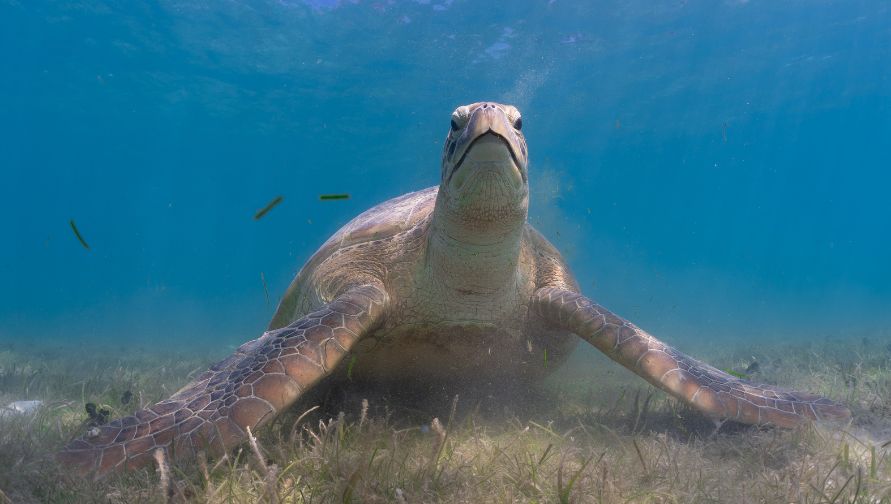
When you imagine 2,000 green turtles, you’re probably picturing a massive flotilla of wise-looking sea turtles, their soft round heads looking over at you in mild curiosity.
Did you know? The collective noun for a group of sea turtles swimming together is called a ‘flotilla’. However, a group of ‘turtles’ on land can be referred to as a ‘bale’.
And while one can dream of such a gathering, this milestone looks rather different in reality in the Maldives. It is a result of over 16,000 sea turtle sightings, reported by more than 1,000 people over 15+ years.
These sightings form part of ORP’s citizen science Photo-ID programme, which combines documented encounters from trained staff, along with observations from the general public to allow us to monitor sea turtle populations across the country. This month, the programme is celebrating its 2,000th identified green turtle in the Maldives!
But what does ‘identifying sea turtles’ actually mean?
What do we mean by identifying green turtles?
Every sea turtle has a unique pattern of scales on its face, much like a fingerprint. Across the Maldives, our team and citizen scientists photograph sea turtles they encounter, taking particular care to capture the individual’s facial scale patterns while adhering to our Code of Conduct.
Our scientists then use these photographs to identify each sea turtle and add the observation to our country-wide database. When a new sighting comes in, we can compare it against the sea turtles we’ve already identified and determine whether we’re looking at a new individual or one we’ve encountered before.
So we’re not just counting sea turtles; by recording identified individuals over a period of time, we’re beginning to build a picture of who these sea turtles are, where they go, and what they do – or what scientists call ‘population studies’. This helps us understand how healthy and stable sea turtle populations are, whether they are increasing or declining, and ultimately helps guide conservation action.
And after thousands of encounters, we’ve started to notice some fascinating patterns and behaviours!
Did you know? Green turtles in the Maldives are still classified as Endangered, even as their global conservation status has improved to Least Concern.
1) Green turtles are most frequently seen in seagrass meadows
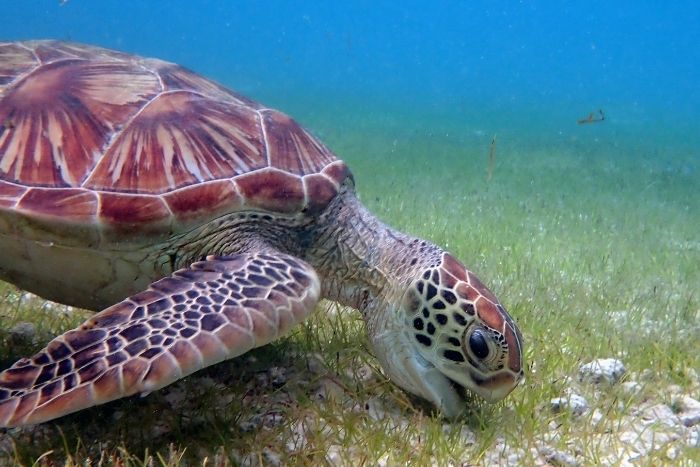
This is not too surprising, since one of their favourite foods is the tasty seagrass! Meadows covering shallow Maldivian lagoons are also easily accessible when snorkelling, giving citizen scientists a great chance to see the green turtles munching on the grasses and capturing great pictures of them.
2) The reef is a favourite spot to rest
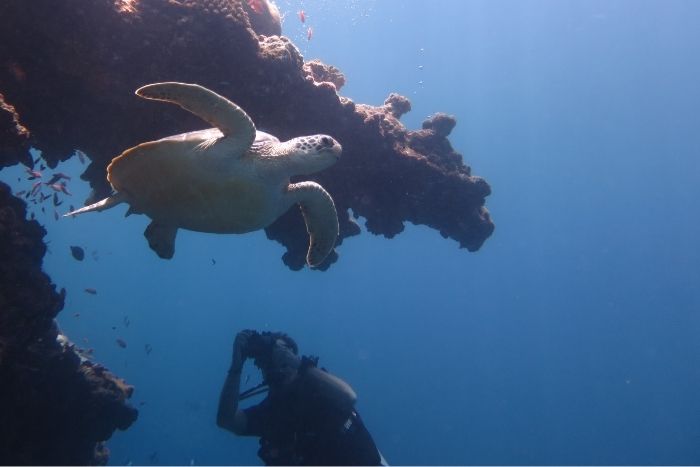
Green turtles are also frequently seen on different reefs, most often using overhangs or cozy spots between coral bommies (isolated underwater pinnacles or columns of coral that rise up from the sea floor toward the surface) as resting spots.
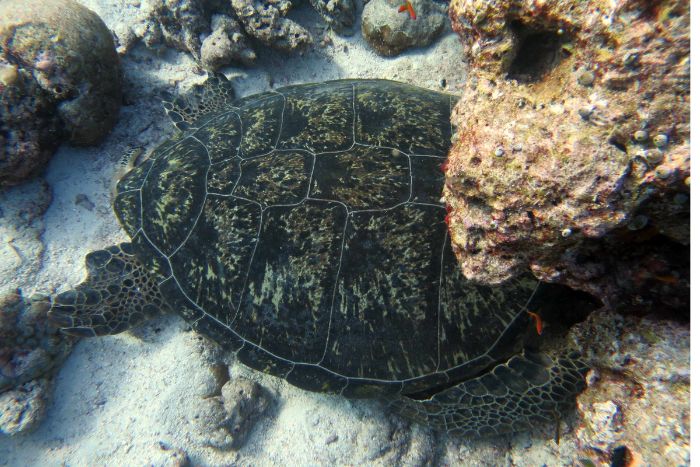
Some green turtles have even taken up the habitat of resting with their head wedged closely inside the overhang, posing a more challenging task for those with a camera looking to find out who is taking a rest on the reef. Interestingly, many green turtles have been observed to develop a special attachment to a distinct spot on the reef and so can be reliably seen in “their” overhang over and over again.
3) Multiple green turtles on one site can go well – or not!
Our Photo-ID programme has identified certain hotspots for green turtles. These are reefs or seagrass meadows where a larger number of green sea turtles have been identified and can be spotted reliably over and over again. Sometimes, these green turtles have been observed to peacefully coexist, foraging or resting next to each other. Other times, however, the meeting of two greens does not end quite as calmly!
Green turtles have been observed to show aggression towards each other when it comes to sought after resting spots or cleaning stations. We have also observed inquisitive, often young greens, invading the personal space of other sea turtle individuals, sometimes resulting in the sea turtle equivalent of a stern telling off!
As reptiles, sea turtles are often perceived as not very social animals, but initial evidence from our Photo-ID programme suggests that there might be more to discover, and that all the unknowns about sea turtle behaviour truly warrant further investigation.
Our programme has recorded more juvenile than adult green turtles, but why is that?
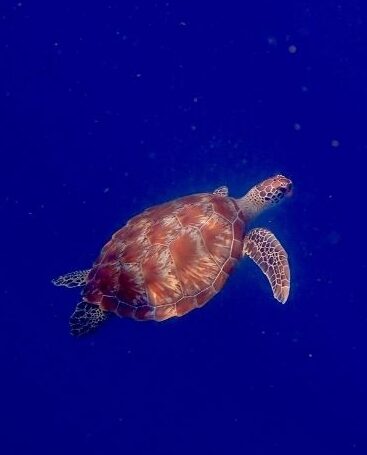
Several factors likely play a role here. Firstly, juvenile green turtles might frequent more shallow habitats than adults, thus being more likely to be spotted by snorkelers and recreational divers.
Secondly, the Maldives might provide a good habitat for green turtles while they grow up, and once grown, adults might shift to other habitats outside the country.
And last but not least, past population declines that affected adults might have led to an overall younger population, which is still in the process of growing up.
4) Why the big yawn?
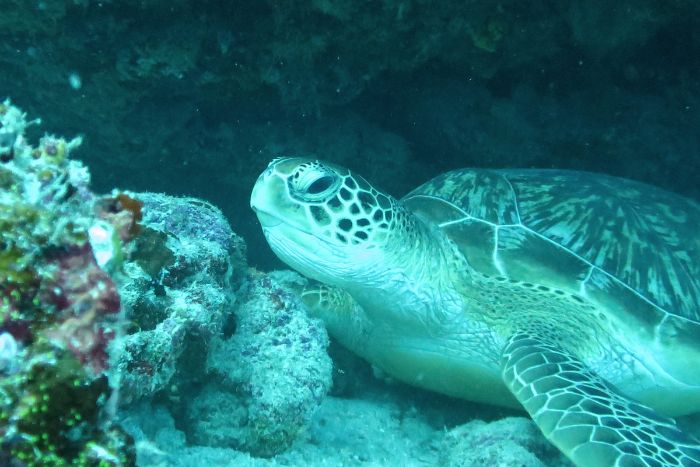
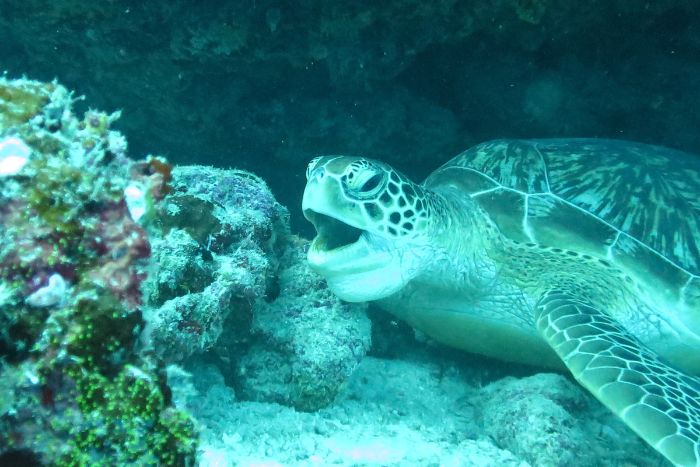
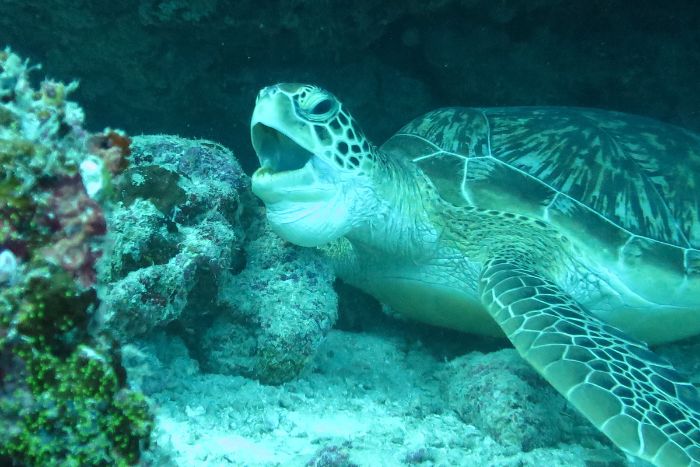
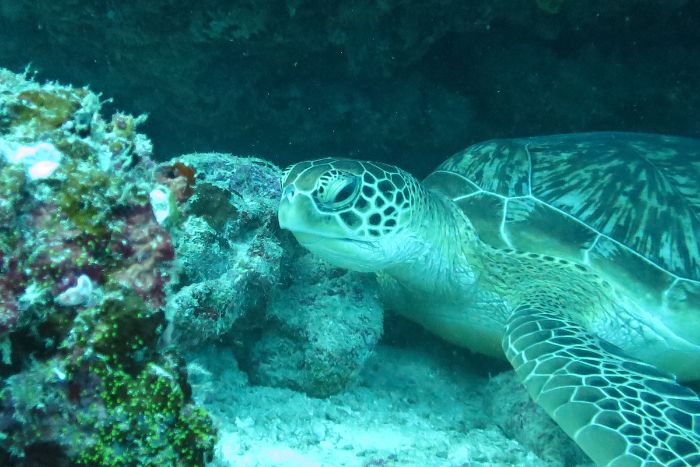
Talking about all of these nice resting spots, did you know that sea turtles also sleep underwater?
Depending on the water temperature, they can stay submerged for one to several hours, resting while holding their breath. Despite not breathing while underwater, green turtles have been observed with mouths wide open, especially while settling in at their resting spots. They sometimes follow this by closing their eyes and going to sleep – it looks just like how we yawn before we settle into our beds! ‘Fredy’, pictured above is effectively demonstrating the cycle of a sea turtle ‘yawn’.
While the behaviour is rarely documented, there is some debate about the exact function and scientists hypothesise that the jaw movement during a ‘yawn’ is used to stretch the jaw muscles and suck water into the mouth cavity to allow sea turtles to better “smell” their surroundings. It is clearly different from a human yawn, even if it looks quite similar!
5) Moving onto land – the nesting challenge
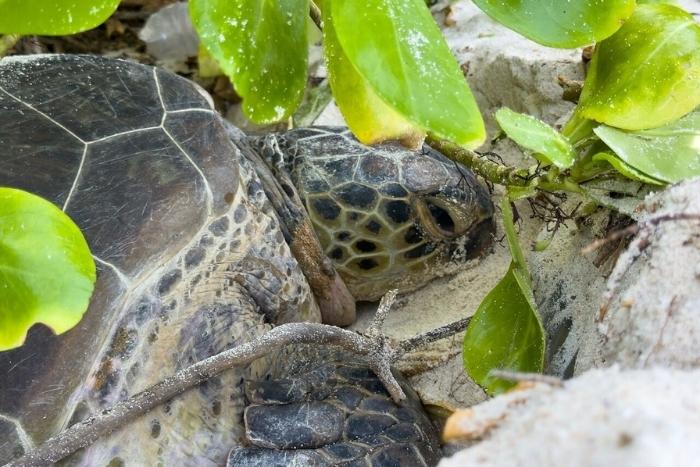
Lastly, the green turtles in the Maldives also use areas outside of the water, specifically Maldives’ sandy beaches to nest. Our Photo-ID database also includes ID photos of nesting females, which is one of the reasons why we have identified more females than male green turtles.
Using Photo-ID on nesting beaches helps us track how long females take between laying multiple nests in the same season, and between different nesting seasons that they are active in.
In fact, our 2,000th identified sea turtle was a really special one – a nesting female that came to the beach during daylight hours that was sighted at Gaadhoo, one of the country’s famous nesting hotspots! Sea turtle ranger assistant Sharoof spotted the female and took the opportunity to add her to our database.
Now that we have reached the end of our list of fascinating insights, we’d like to invite you to keep this effort going.
Because, even though we may not have a flotilla of 2,000 green turtles swimming together just yet, we do have something arguably more useful – 2,000 individual green turtles, each with a story to tell. And behind every one of those sea turtles is a person who chose to stop, look a little closer, take a photograph, and contribute to sea turtle research.
How can you be part of the next 2,000
- Spotted a sea turtle? Share the sighting with us: If you’re visiting the Maldives, or know someone who is, share our citizen science Photo-ID initiative with them. If they happen to encounter a sea turtle, they can submit their photographs to our database and even find out who they’ve seen. They might even photograph a sea turtle we’ve never encountered before.
- Get to know a green turtle from afar by naming and adopting one: Not heading to the Maldives anytime soon? You can still get involved by adopting a sea turtle. You’ll receive a digital adoption certificate and, if you’re adopting for a child, a fun digital activity pack to go along with it. You can also choose to receive updates when your adopted green turtle is re-sighted, giving you the chance to follow its journey over time.