
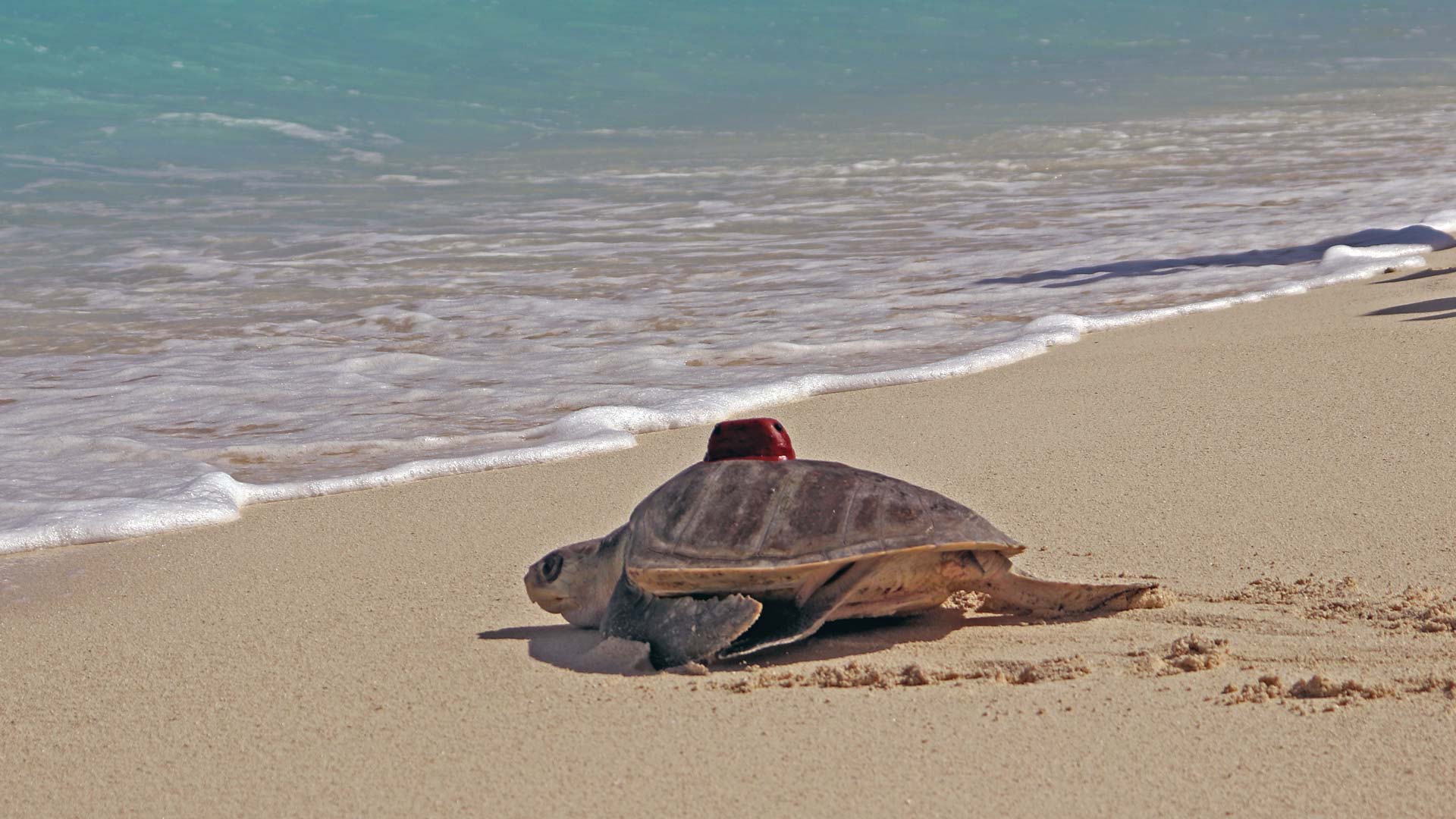
In the Maldives, olive ridley turtles are often found in ways we wish we would never find them: entangled in ghost nets, sometimes injured to the point where they cannot survive without help.
These injured sea turtles are brought to the Marine Turtle Rescue Centre (MTRC), where they are clinically treated before being released back to the ocean so that they can continue on their journey. But where exactly are they going? And how do we learn more about their journeys?
How do we follow a sea turtle?
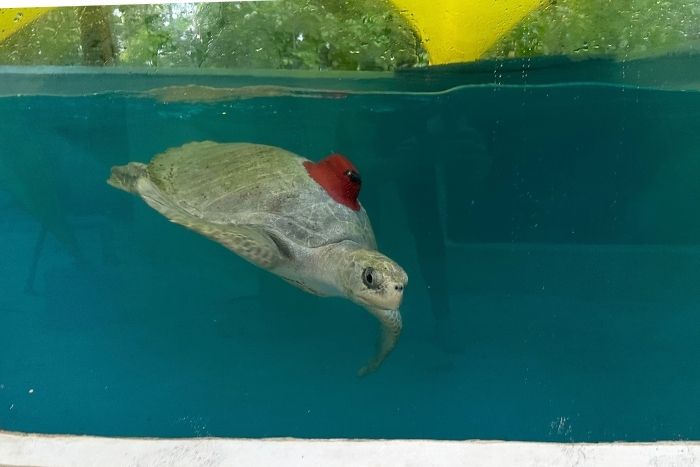
Satellite tracking is a useful way of understanding exactly where sea turtle individuals are coming from or where they go.
It involves attaching a small satellite tag on the sea turtle’s shell. Once the sea turtle swims back into the ocean, the tag sends location data to a satellite at pre-set intervals, for example, every 6, 12, or 24 hours – depending on what the researcher is trying to find out.
These locations allow us to map the sea turtle’s movements and equally importantly, identify areas where it may be stopping to forage.
How much do we know, or don’t know about where olive ridleys go?
There have been many studies looking at where olive ridleys in the Indian Ocean go. Many of these have focused on nesting females from beaches in Odisha, India, and have shown that the females after laying their eggs, travel out into the Bay of Bengal.
This is useful information, but it tells us about only one particular demographic of the much larger olive ridley population since:
- The individuals tagged are only females, since they are the ones that come ashore to nest.
- Being nesting females, the tagged individuals are all adults.
This means that we are missing out on males, juveniles, and even individuals who may be nesting on other beaches. Together, these represent a large part of the population whose movement behaviour we know less about.
Understanding what these populations do or where they go is important – do they forage in the same areas as adult females? Do they have same migratory routes?
Such questions are largely unanswered, but the information remains critical for identifying important foraging habitats. This knowledge then helps advocate for policies that can protect these habitats as well as the sea turtles that depend on them.
A drop in the ocean: The problem with finding olive ridleys in the open ocean
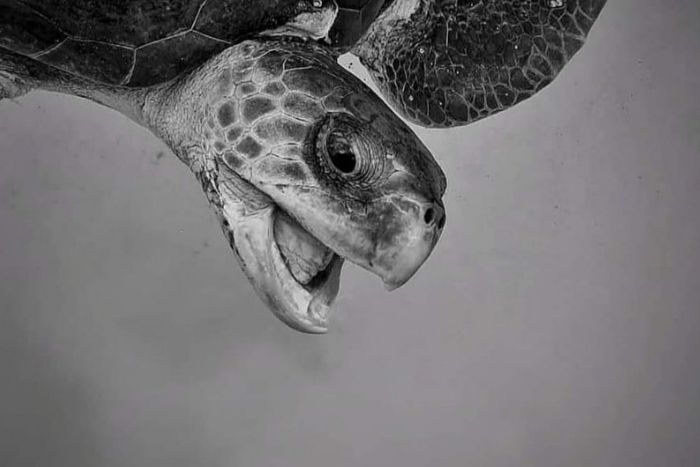
In order to tag olive ridleys (individuals that are not nesting females), we first need to find them, which is a particularly hard task.
Other sea turtle species, such as hawksbills, green turtles, and loggerheads, can often be found in nearshore habitats like coral reefs and seagrass meadows. These habitats are relatively limited, spreading only a few kilometres from shore, with their locations known through previous research, local knowledge, or satellite imagery.
This gives researchers somewhere to start looking. Finding and tagging a sea turtle associated with these habitats is still far from easy, but at least we know where to look.
Olive ridleys, on the other hand, are highly oceanic and spend much of their life in the open ocean. Therefore, trying to find olive ridleys in the middle of the Indian Ocean is many times harder and far more expensive than finding a needle in a haystack (I have personally never tried but I am sure the former is harder).
A match made at sea

The olive ridleys that come into the MTRC provide a workaround to this problem.
Some of these olive ridley patients that come into our care are males, some are juveniles, and some are females. It is also possible that some of these individuals had actively been foraging when they became entangled in ghost nets.
Our primary objective at MTRC is to treat these sea turtle patients and return them to the ocean. But if we fit them with satellite tags when they are released, we can continue to follow their journeys and potentially answer some of the questions we raised earlier.
There is also good reason to think that these tagged olive ridleys may be able to take us back to their foraging grounds, as studies have shown that sea turtles can return to their foraging sites after being displaced. So these previously unknown habitats can now be known!
Interestingly, satellite tracking studies of olive ridley females in Odisha have shown that the Bay of Bengal is an important foraging seascape for them. In this bay, the tagged females show meandering movements, travelling between areas of restricted search before moving again. This gives us an interesting glimpse into how olive ridleys may move while foraging.
But the Bay of Bengal may not be the whole story. There could be other important foraging areas elsewhere in the Indian Ocean, as well as other ways in which olive ridleys move and forage that we simply do not know about yet. This is something that our tagged and tracked sea turtle patients could help uncover.
The beginning of ORPTrack
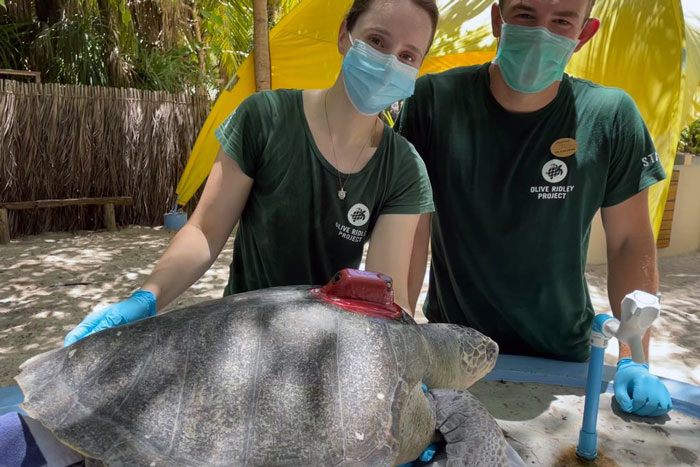
And so, in 2022, ORPTrack began – our satellite tracking research project, through which we aim to gain better understanding of the feeding habits and habitat use patterns of olive ridley turtles. Now four years later, we are pleased to share the first findings from our project, published in Endangered Species Research on September 10th 2026. This paper presents the findings from our first cohort of olive ridleys, tagged between April 18th, 2022 and September 14th, 2023. Five olive ridleys – Autumn, Pickle, Shara, Muraka, and Hawwa – were treated at MTRC, before being fitted with satellite tags and released back into the ocean. Of the five, Pickle and Shara were females and the only adults in the tagged cohort.
What did we find?
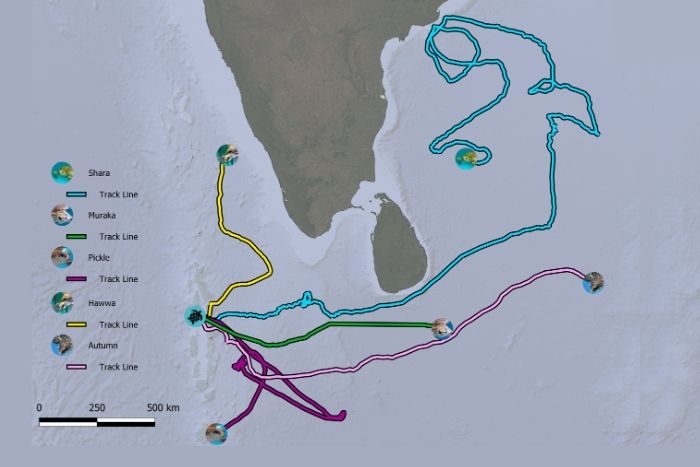
The first thing we noticed was that the five tagged sea turtles dispersed in different directions, all moving differently.
Muraka and Autumn travelled east from the Maldives, apparently towards maritime Southeast Asia. Hawwa headed north towards the western Indian Ocean, while Shara travelled east into the Bay of Bengal. Pickle made quite a number of turns just east of the Indian Ocean, before changing direction and heading back down into the Maldives.
Now let’s take a look at how their journeys looked and what we could learn from them.
- Muraka and Autumn, journeys cut short: Muraka and Autumn’s satellite tags stopped transmitting before they could reach their foraging areas. Our spatial analyses indicated that both individuals were still on migratory tracks when their tags stopped transmitting. Their journeys therefore ended before we could see where they eventually settled.
- Hawwa, a possible threat interaction: Hawwa’s track was more unusual. Their track travelled towards the western coast of India before following an unusually straight path to shore. It then appeared to head back out to sea, at a speed much greater than a sea turtle’s, before returning to the same location on the coast again. We suspected that either Hawwa or the satellite tag may have been picked up by a boat and transported between the sea and shore. While we hope it was the tag rather than Hawwa, this does highlight a major threat sea turtles and other marine megafauna face across the world – bycatch and interactions with fishing vessels in the ocean.
- Shara, a possible connection to Odisha: Shara’s journey provided one of the clearest links to what we already know about olive ridleys in the region. She travelled into the Bay of Bengal, where she made a number of stops. Her movements within the Bay of Bengal were similar to those recorded in previous studies of nesting females from the mass-nesting population in Odisha, India. This raises the possibility that Shara may have come from this well-studied population. But we cannot confirm this from her track alone. To know for certain, we would need to compare her DNA with that of olive ridleys from the Odisha nesting population. However, previous DNA research conducted by ORP’s founder & CEO Dr Martin on rescued olive ridleys from Maldives has already hinted at this connection, making this a real possibility.
- Pickle and the possibility of olive ridley foraging grounds in Maldives: Pickle’s journey was perhaps the most surprising. We initially expected her to head east, in the same direction as Muraka and Autumn. Instead she made several stopovers east of the Maldives before turning back towards Huvadhu, the southernmost atoll of the Maldives. Her transmissions ended before we could determine whether she had actually stopped and begun foraging around Huvadhu, or had moved on to elsewhere. This is still interesting because the Maldivian archipelago is not currently known to support a permanent foraging population of olive ridleys. But Pickle’s movements, as well as occasional citizen science encounters with olive ridleys in the Maldives, appear to tease this conclusion. So could olive ridleys be using Maldivian waters as a foraging habitat? For now, we do not have enough evidence to say. More satellite tracking data, and more tagged sea turtles, would be needed to determine what was happening. Until then, a permanent olive ridley foraging population in the Maldives remains a speculation. But we can certainly dream, can’t we? And dream on we shall!
We’re not done yet!
This study supports what other studies have found on oceanic olive ridleys, whether in the Indian Ocean or in other ocean basins: that their foraging sites could very well be widely distributed across a single seascape.
More importantly, this study adds new clues to our knowledge of where some of these foraging habitats may be within the Indian Ocean. But the work does not stop here. Two additional sea turtles were tagged before they could be included in this study, and we plan to tag more olive ridleys in the future.
Ultimately, the goal is to turn these individual journeys into knowledge that can help inform policies to protect olive ridleys and their habitats across the wider Indian Ocean.