
Data collection for us sea turtle nerds is sacred – counting nesting sea turtles, eggs laid, hatchlings etc – it’s information we tend to with great fervour and care. It is this knowledge that powers actionable solutions after all.
But somewhere between all the counting and analysing, we sometimes forget to pause and marvel at the very rituals we routinely study.
And you know who reminds us of this sense of awe? YOU!
One such moment came when we hit 28 Million views on one of our videos on Instagram. To our surprise, we had gone viral! With 500 comments and counting, people asked questions, expressed amazement – we were reminded of just how lucky we are to know these incredible animals.
So we present the video to you here, with an explanation in tow, accompanied by other interesting things you may not know about sea turtle nesting.
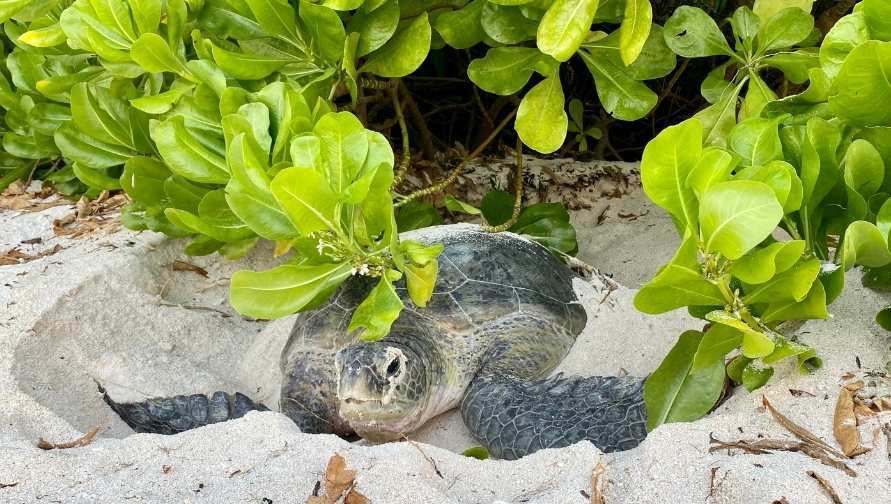
1) Sea turtle mamas while nesting, will use their back flippers as a scoop to dig a hole as deep as 45-100cms
One of the biggest reactions to this viral video was people expressing surprise at the dexterity of the sea turtle’s flippers. Some even compared the digging technique to an excavator! How could an animal so perfectly adapted to ocean life perform such a precise land-based task?
It’s true that sea turtles’ flippers are highly specialised for marine life, their long wing-like forelimbs providing propulsion and speed, while the shorter and broader hind-limbs function as rudders for steering and balance.
But for females, the back flippers serve another crucial purpose: digging for nests.
Interestingly, a sea turtle’s front flippers have the same bones as our arms and fingers, but that is where the similarity ends. Their wrist is more flattened, and the digits are not separated like ours. Instead, theirs are elongated to form a single-surface paddle-like flipper adapted for swimming.
And the sea turtles’ hind flippers contain the same basic bones as our legs and feet, but unlike their stiff front flippers, the back flippers remain flexible. During nesting, female sea turtles will curl their back flippers inward and use them like scoops to shovel sand out and carefully shape their nests (as pictured in the video above).
For an animal so highly adapted to life in the ocean, this retained functionality of the hind limbs for digging is truly fascinating!
2) Fairy eggs in a sea turtle nest?
No, not actual fairy eggs, that would take us from awe to absolute fantasy.
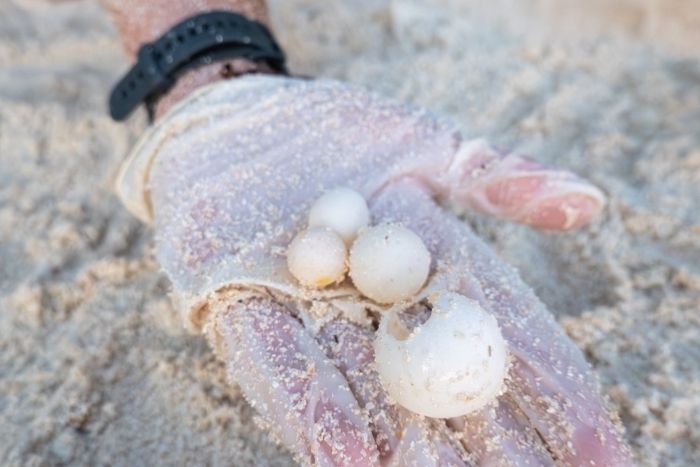
Fairy eggs, if you’ve heard the use of the term in the context of chicken eggs, are unfertilised eggs containing no yolk. Interestingly, these eggs can be found in sea turtle nests too. They’re easily distinguishable since they’re much smaller, containing only the albumen and a shell, lacking both a yolk and embryo.
These unfertilised yolkless sea turtle eggs, known as ‘spacer eggs’, are believed to serve an actual purpose in sea turtle nests:
- These smaller eggs act as physical spacers, creating tiny air pockets between normal eggs in the sand. This improves oxygen flow, which the developing embryos in the nest respire and absorb through their eggshell.
- Spacer eggs are often laid at the top of the clutch, acting as decoys for predators digging into the nest.
- Spacer eggs even release moisture to the fertilised eggs, preventing them from getting dehydrated.
Researchers believe these eggs to be a natural byproduct of the reproductive process, caused by factors possibly related to the nesting environment and/or the health of the nesting mother.
So while spacer eggs never become hatchlings themselves, they may still help improve the survival chances of the rest of the nest. Pretty fascinating, right?
3) Sea turtle nests can drown!
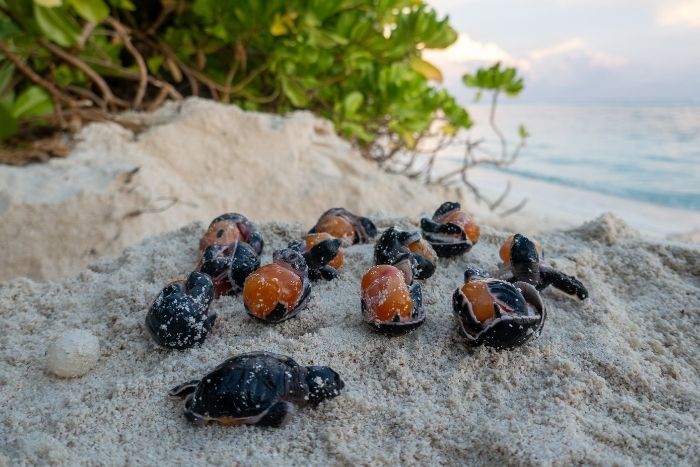
While it is true that sea turtle eggs develop buried safely in beach sand, that doesn’t necessarily mean they’re naturally protected from flooding (from wave action, high tides etc).
Sea turtle embryos developing inside their eggs rely on a two-way exchange of oxygen and carbon dioxide through microscopic pores in their eggshells. When nests get flooded by ocean tides or heavy rain, this airflow can get blocked, causing the embryos to suffocate. And the longer a nest remains submerged, the lower are the chances of successful hatchling development.
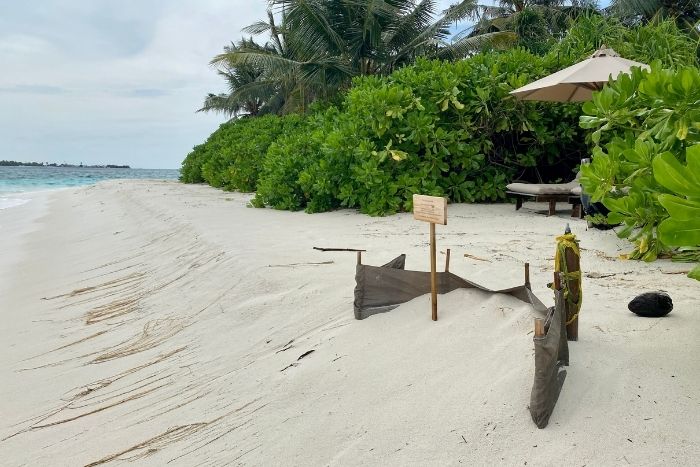
This is becoming an increasingly serious challenge as rising sea levels, coastal erosion, and more intense storms threaten nesting beaches worldwide.
That’s why many conservation organisations, including ours, closely monitor nesting and relocate vulnerable nests to safer areas when necessary.
4) Is the famous ‘1 in 1000 hatchlings survive to adulthood’ statistic accurate?
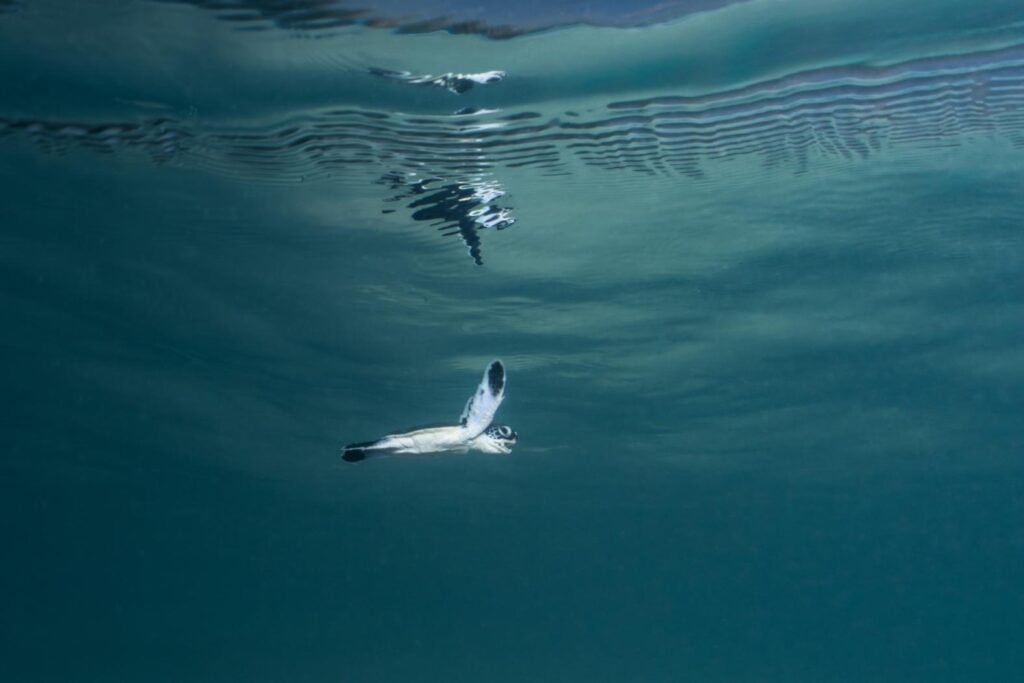
If you have ever engaged with sea turtle conservation, chances are you have heard this statistic before – 1 in 1000 hatchlings survive to adulthood.
This estimate comes from a study conducted over 40 years ago, so how does it hold up now, with more modern methods of population research and study? And the question on everyone’s minds, is this number truly accurate?
Well to begin with, 1 in 1000 hatchlings surviving to adulthood is more a ‘rough guess’ than a fact.
Recently, new research by Hays et al. (2026) has used up-to-date figures to re-calculate the survival rate and showed that the real numbers are somewhere between 1 in 400 to 1 in 2000 baby sea turtles surviving to adulthood.
However, the researchers also caution that hatchling survival rates can vary widely across populations and species, depending on factors like adult survival rate, number of nests laid per season, conservation management, and threat pressures like bycatch.
So while the popularity of the 1 in 1000 estimate is within the general scale of survival rates, the number is not an absolute. And perhaps this uncertainty is one of the most exciting things about science: our understanding of the natural world is constantly evolving, with every new discovery giving us another way to understand and engage with nature.
5) Sea turtle mamas fast for four to eight weeks during nesting
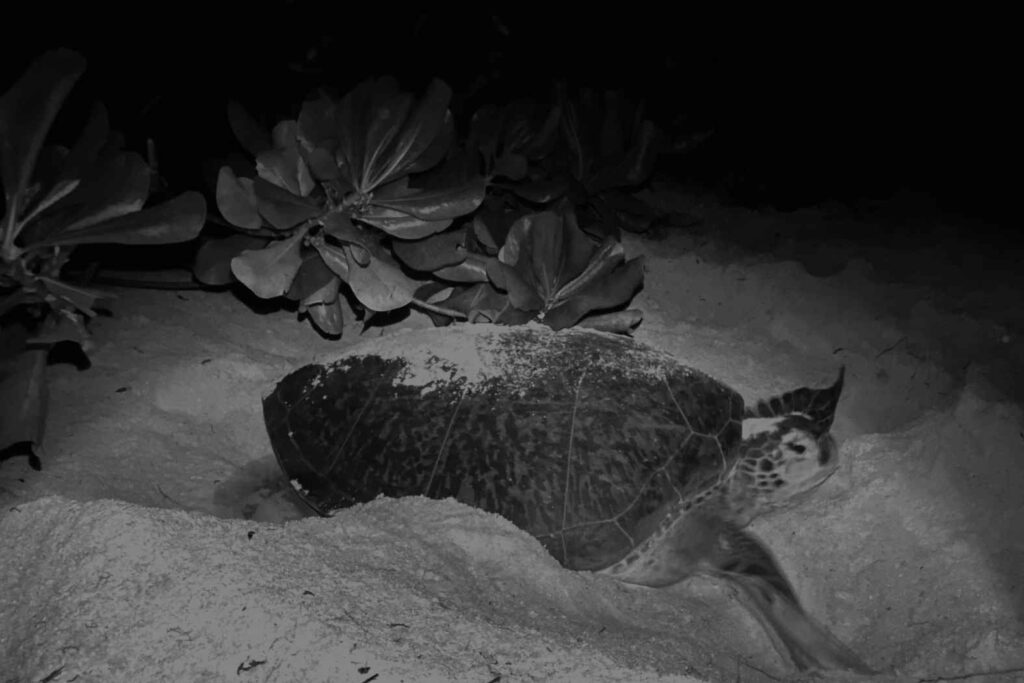
For female sea turtles, the process of nesting is so exhausting that most species reproduce once every two to five years, using the downtime to recover their strength.
Before nesting even begins, females often migrate hundreds to thousands of kilometres from their feeding grounds to their breeding grounds. Once they arrive in waters close to nesting beaches, they mate offshore and then emerge on land to lay multiple clutches of eggs over the course of the nesting season.
A single female can lay between two to seven nests, returning to shore every couple of weeks across a single season. During this time, she eats little to no food, surviving entirely on the fat reserves she spent months building up at her foraging grounds before the breeding season.
During nesting, she expends massive amounts of energy, and loses a serious amount of body weight – it’s true, the whole ordeal takes a massive physical toll on the mama. But she perseveres, like a she-ro!
Only once nesting is complete does the mama finally return to her feeding grounds to recover and replenish those crucial fat reserves, before repeating the entire process again a couple of years later.
So next Mother’s Day, spare a thought for the sea turtle mama, one of the ocean’s most extraordinary mothers.
We hope you enjoyed these lesser-know facts about the nesting process. If you’d like to help protect nesting sea turtles, here are a few ways you can make a difference:
- Check out our nesting protocol to make sure you’re following best practices around nesting mamas
- Adopt one of our female sea turtle patients in recovery at our clinical facilities
- Tune in to our podcast episode exploring the fascinating world of sea turtle nesting with Dr Jeanne Mortimer from Seychelles