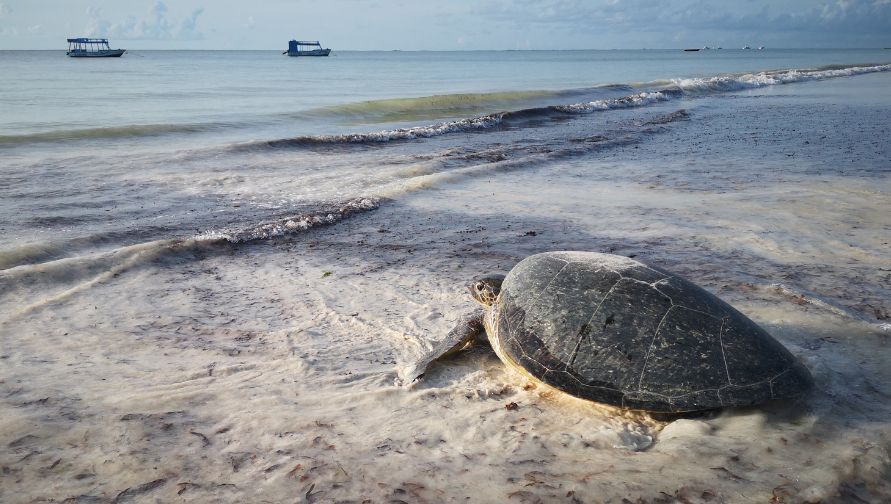
As the sun sets over Kenya’s coastline, a visitor emerges from the sea, its flippers and domed body faintly illuminated against the horizon.
The visitor, a female sea turtle, hauls herself onto Jumba beach with much effort. Guided by instincts that have brought her back to the very beach where she hatched many moons ago, the female begins digging her nest.
Unbeknownst to her, someone in the distance watches her every move carefully. Once her nest is dug, the female enters a trance-like state and begins laying her eggs.
This is the moment our team emerges from the shadows. With practiced hands, they first measure the tracks in the sand. Then, as the female begins covering her nest, they quickly measure her carapace, attach small flipper tags to her front flippers, and take her photograph for identification.
Scientific observances completed, the Olive Ridley Project–Kenya (ORP–K) team retreats. They watch until the female returns safely to the ocean, leaving the next generation of sea turtles buried beneath the sand.
But the hatchlings developing in the nest aren’t alone. Our team will continue to keep vigil, protecting new life and with it the enduring world of sea turtles.
Protecting Jumba and its inhabitants
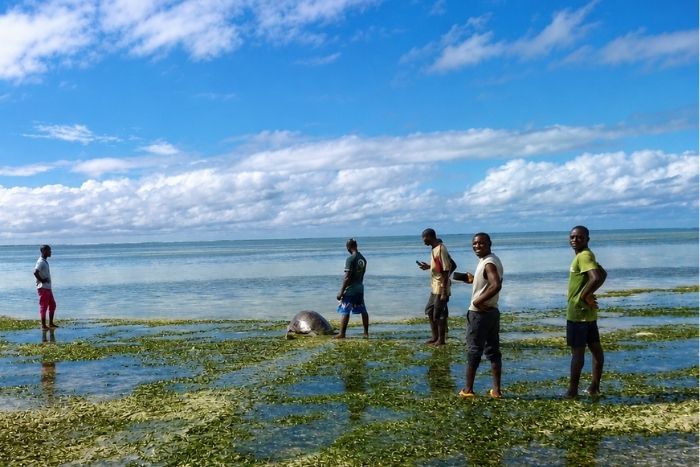
These community sea turtle monitors represent the newest chapter in ORP–K’s conservation efforts. Until the end of 2025, Kenya team’s work in sea turtle monitoring had focused exclusively on the species’ presence in underwater ecosystems.
Now. in present-day Kenya, by conducting nest monitoring at Jumba – one of the country’s most important nesting beaches, ORP–K is protecting sea turtles and their habitats not only at sea, but also on the shore.
However, this exciting milestone is not ours alone, rather, it was made possible through the impressive foundation already in place at Jumba. Since 2013, sea turtle nesting at Jumba has been monitored by the Jumba Turtle Patrol (JTP), a community-led initiative previously managed by local artist Roger Jessop. Through regular beach patrols, nest monitoring and community engagement, JTP documented more than 1,000 nests between 2014 and 2025, helping over 84,000 hatchlings reach the ocean safely.
In February 2026, on Roger’s request, ORP–K took over management of the project to ensure its long-term future, both for the benefit of sea turtles and the community members.
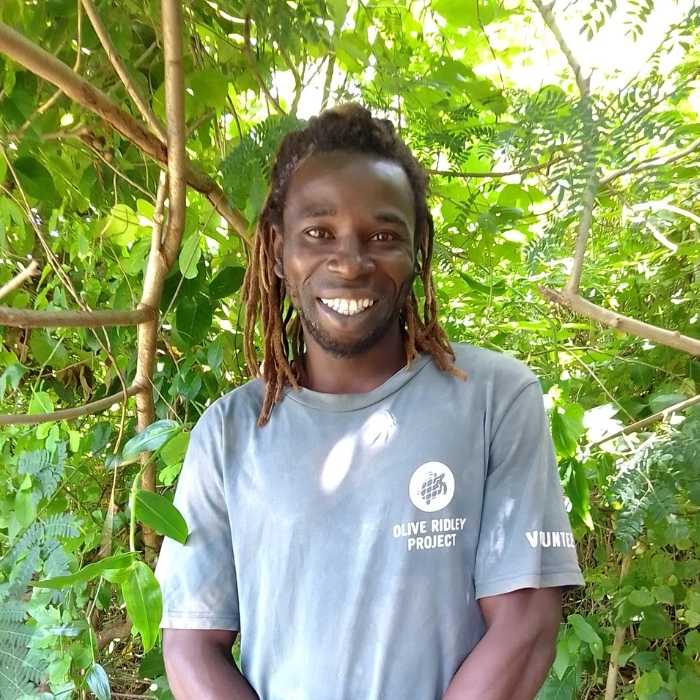
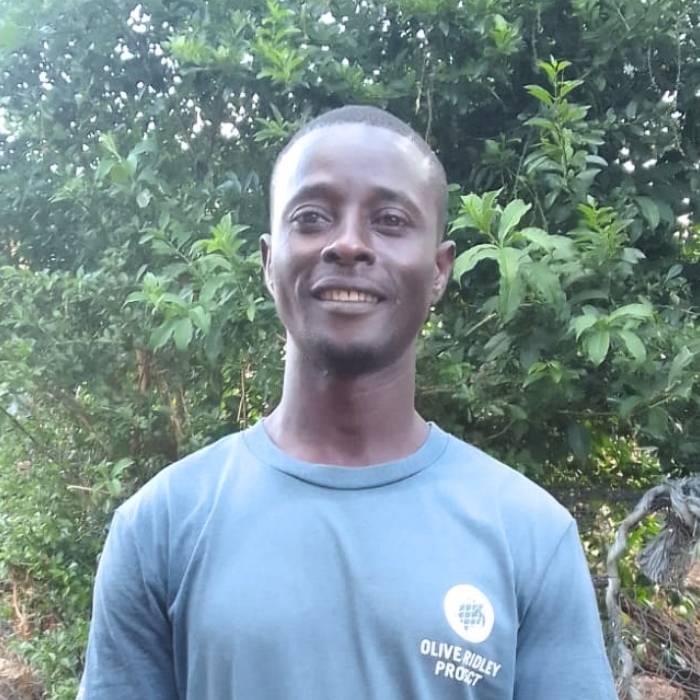
Today, the same local monitors (pictured above) protect Jumba Beach as part of ORP–K, combining years of experience and local stewardship with organisational support. Guided by our sea turtle biologist, Kelvin, the community sea turtle monitors document nesting activity each night, building on more than a decade of data that guides conservation at Jumba – the need for which becomes clear when one looks at the conditions that define the region.
Why Jumba beach?
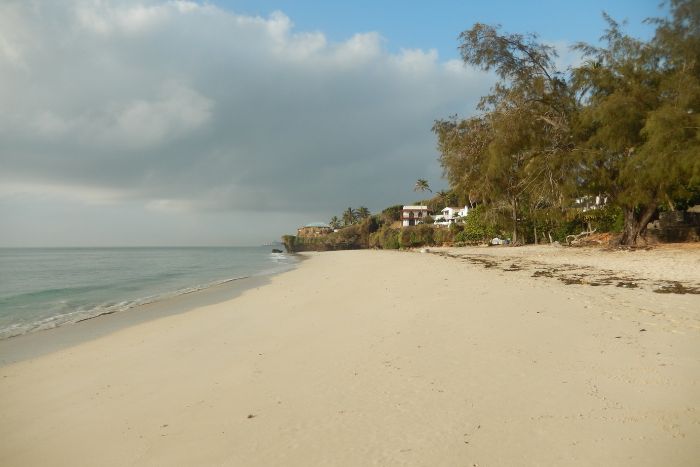
Stretching less than one kilometre along the coastline of Mtwapa, Jumba Beach may be small, but it plays an important function for sea turtles nesting along Kenya’s coast.
During peak nesting seasons, the beach has been known to record more than 100 nests, primarily from green turtles, with occasional olive ridleys and hawksbills. Unfortunately, this nesting site, much like many others around the world, faces challenges from both human and natural threats.
Historically, Jumba along with its neighbouring coastline has been an active site for illegal harvesting of sea turtle eggs and meat. At the same time, coastal erosion has degraded suitable nesting habitat, particularly along the beach’s northern cliffs. Not only does this put nesting females at risk, leaving them to scale unreliable terrain, it also reduces available space for nest building. When eggs are laid too close to the high tide line, they run the risk of getting washed away or flooded by seawater. And to make matters worse, accumulating marine debris along the shore chokes off the remaining nest space if left unmanaged.
These challenges, along with existing natural threat of egg and hatchling predation by ghost crabs, make survival for sea turtle babies tougher than usual.
Therefore, the ecological importance of Jumba Beach, coupled with the growing pressures it faces, has reinforced ORP–K’s resolve to ensure continued protection of this beach and its inhabitants.
Blending community management with scientific rigour
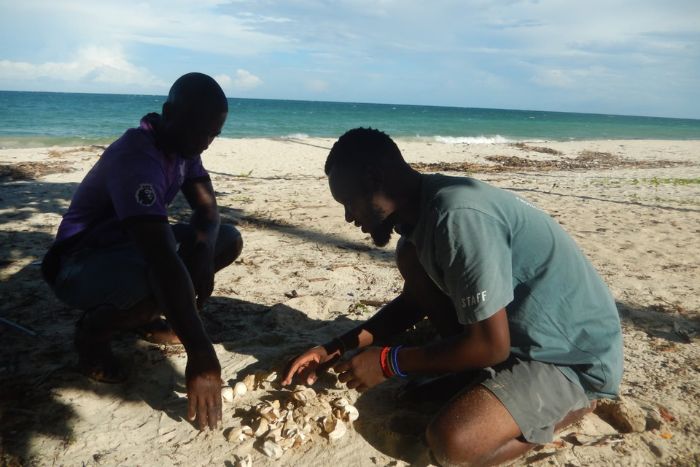
Today, ORP–K’s Nest Monitoring Programme at Jumba combines local knowledge with scientific data collection to inform management and protection of nesting sea turtles. Here’s how we do it:
- Community-led beach patrols: Throughout the nesting season, experienced community monitors patrol Jumba Beach every night, reporting nesting activity, hatching activity, and keeping an eye out for distrubances. Their consistent presence on the beach as well as their local knowledge of the landscape and sea turtle behaviour form the backbone of the programme.
- Recording nesting sea turtles: All sea turtle activity is notified to ORP–K’s sea turtle biologist, who together with the community sea turtle monitors, documents every nesting female through flipper tagging, photo-identification, carapace measurements and other biological records such as injuries or scarring. This data is logged and digitised to help identify returning turtles and monitor nesting trends.
- Protecting vulnerable nests: Nests are monitored daily to protect them from threats, including erosion, flooding or human disturbance. Where required, the nests are carefully relocated in accordance with Kenya Wildlife Service guidelines and ORP protocols. These relocations are carried out only when necessary to improve hatchling survival and reduce disturbances to the embryonic development process.
- Monitoring hatching success: Hatchlings are allowed to emerge naturally, without cages, false starts, or unnecessary handling. After a minimum of 48 hours, the team excavates and assesses the nest by recording the total number of eggs laid, emergence success, the number of trapped hatchlings, developmental stages of unhatched eggs, and the depth of the egg chamber. This information reveals trends about nest development and the conditions that improve or even hinder successful hatching.
- Responding to stranded sea turtles: The programme also responds to stranded, injured and deceased turtles found along Jumba Beach and neighbouring coastlines, assisting the Kenya Wildlife Service to document mortality events and contribute to the understanding of threats to sea turtles.
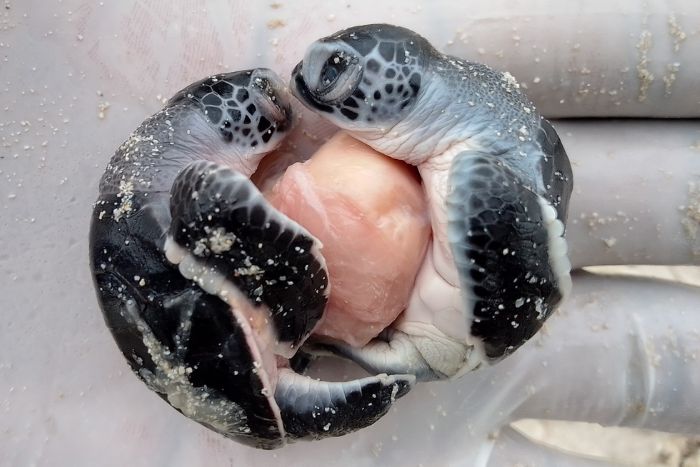
Have you ever seen hatchling twins? Sea turtle hatchling twins are extremely rare. This happens when two embryos develop inside a single egg, sometimes resulting in separate independent siblings, conjoined twins (as pictured), or two-headed (bicephaly) hatchlings. These twins here were recovered from a nest excavation at Jumba.
Looking ahead
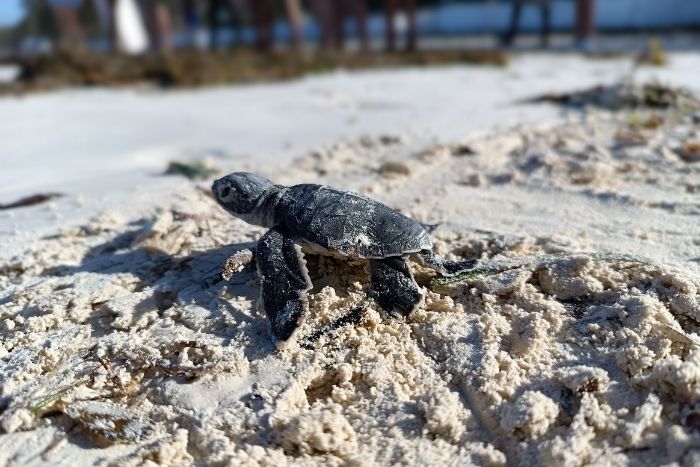
With every nesting season, ORP–K’s work at Jumba Beach will add to one of Kenya’s longest-running records of sea turtle nesting, strengthening our understanding of these animals and the habitats they depend on. And while protecting nesting females and their hatchlings remains at the heart of our work at Jumba, our vision extends beyond the nest.
In the years ahead, we aim to expand our work at Mtwapa, initiating in-water monitoring of sea turtles and stronger community engagement. Using the framework of our existing Sea Turtle Ambassador Programme, we hope to work more closely with Beach Management Units, fishers, schools, and communities across the wider Kilifi County.
As we look to the future, we remain guided by the belief that the strongest conservation efforts are those built on scientific research, local knowledge, and community-led action. Together, they offer the best hope for a future where sea turtles and people continue to thrive along coastlines they have shared for generations.