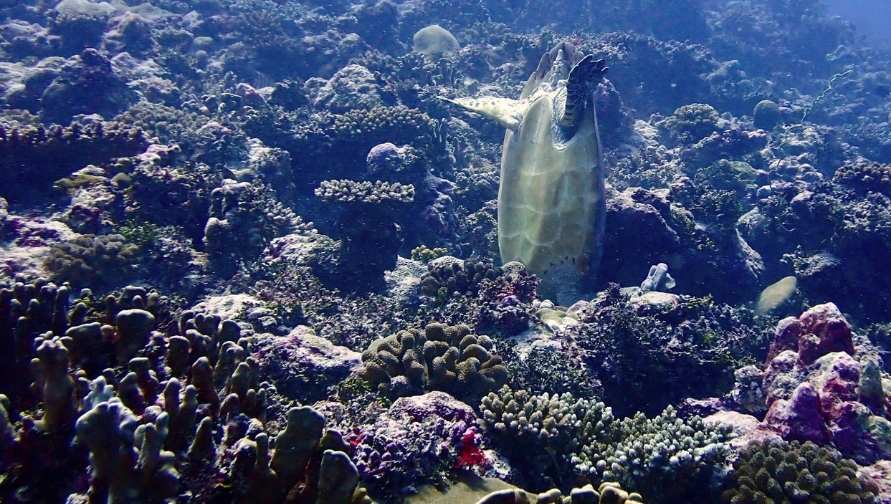
If you’re looking for a hawksbill turtle underwater, chances are you’ll find one upside down on a reef, its sharp, hooked beak reaching deep into coral crevices in search of sponges.
But take a look at Pip here, a hawksbill in its characteristic tail-up-flippers-down feeding posture, only instead of a reef, he’s in a seagrass bed.
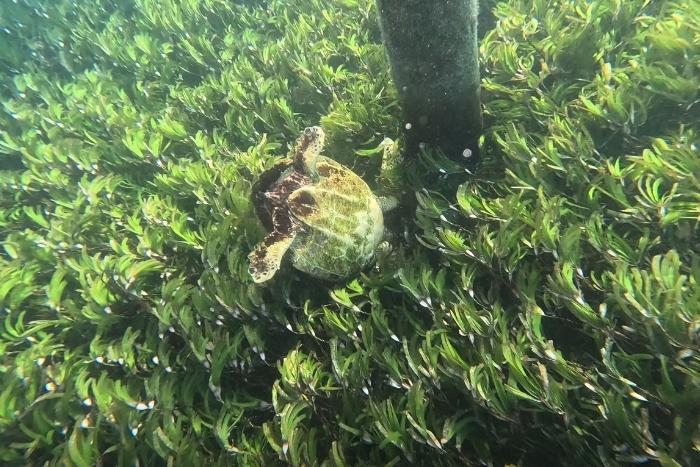
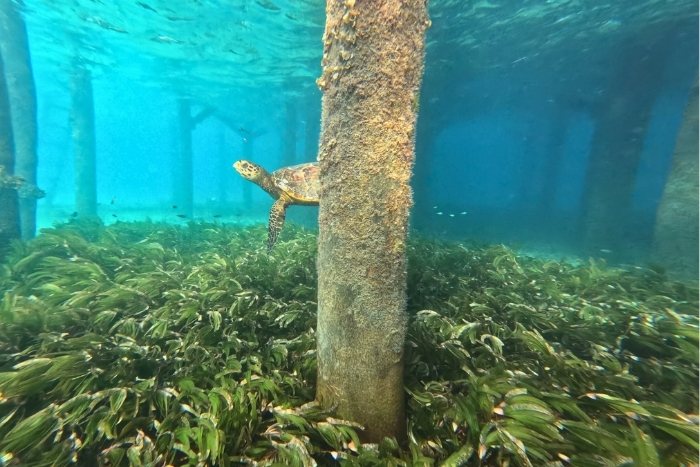
Pip, is a juvenile hawksbill, who has been sighted more than 50 times since March 2020 through our Photo-ID programme. Often seen in Laamu Atoll’s seagrass meadows – a habitat usually associated with green turtles – Pip appears to have developed a penchant for leafy greens.
Yet Pip wasn’t the first hawksbill we had observed behaving this way. He joined a growing list of hawksbills we had already begun documenting – individuals who were repeatedly observed in seagrass habitats.
This led us to ask an important question: was this a series of isolated sightings, or were we beginning to uncover a broader behavioural pattern?
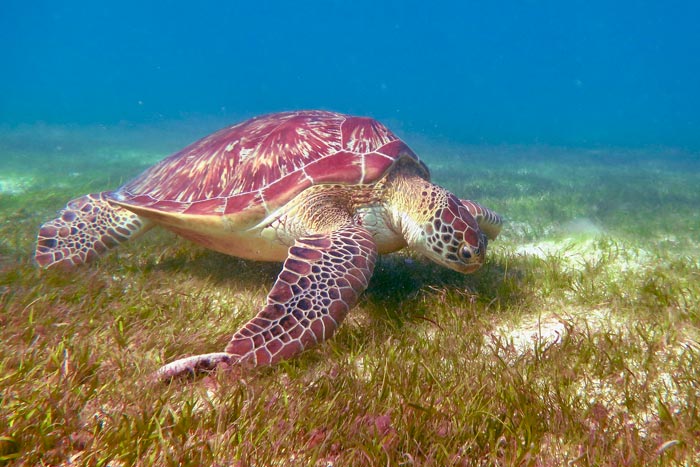
Did you know?
Green turtles’ diet consists of grazing on seagrass, which helps keep these underwater meadows healthy. Seagrass beds are one of the world’s most productive ecosystems – they store large amounts of carbon, provide nursery areas for fish and invertebrates, and support overall marine biodiversity.
Is it unusual to see hawksbills in seagrass?
Hawksbills are strongly linked to coral reefs, but they are not strictly limited to them.
After spending their early years in the open ocean, young hawksbills return to coastal habitats, especially reefs, where they feed and continue to grow. Their bodies are perfectly suited to this reef life. With a narrow head and hooked beak, they can reach into tight coral crevices to pull out sponges – their favourite food – along with other reef invertebrates.
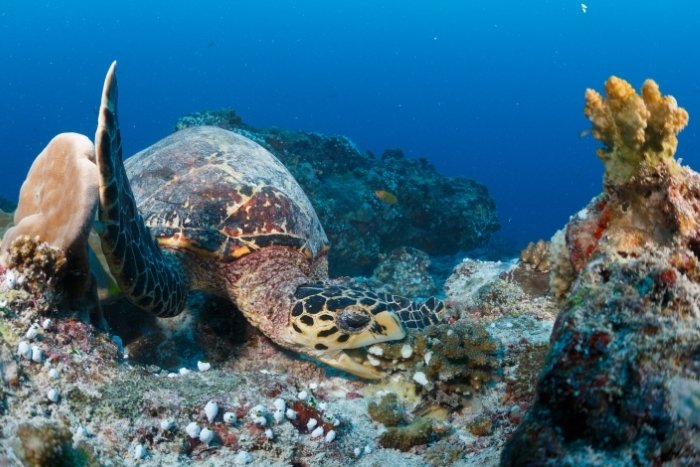
Hawksbills play an important ecological role by helping control sponge populations, thus clearing space for new coral settlement to grow and preventing sponges from overtaking the reef system.
Because of this sponge-dominated diet, hawksbills are most often recorded on coral reefs across the tropics, including in the Maldives.
However, studies from other regions suggest that hawksbills are capable of dietary flexibility. In Honduras, for example, hawksbills have been documented feeding on micro-algae, and using non-reef habitats when sponge availability is reduced. Similar mixed habitat use, including seagrass, has also been reported from other parts of the Caribbean.
Therefore, hawksbills have shown to adapt their diet depending on available food sources – a behaviour that warrants closer inspection of our observations from the Maldives.
What are we trying to find out?
So while the presence of hawksbills in seagrass beds is not biologically impossible, what we don’t understand yet, especially in the Maldives, is:
- How common is this behaviour?
- Is the behaviour sex or age related?
- Is this seagrass foraging is occasional or a regular part of their routine.
In simple terms, we want to know: Are hawksbills in the Maldives using seagrass beds more often than we previously realised?
How are we studying this?
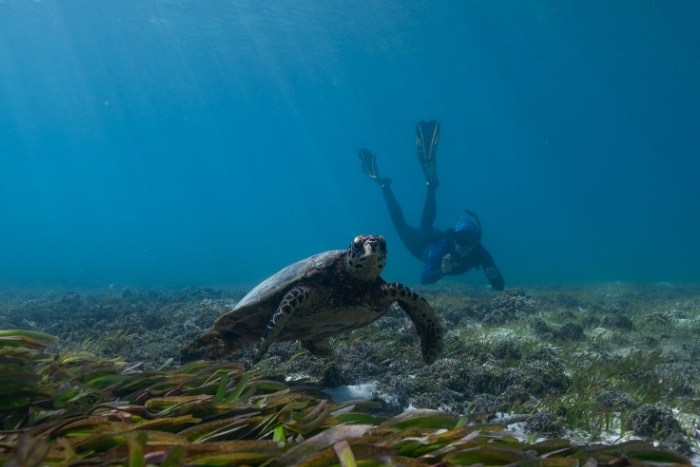
We began our investigation by reviewing our existing Photo-ID database to check for past sightings of hawksbills in seagrass.
Then, between April and November 2025, we carried out focused surveys in selected seagrass meadows in Laamu, Lhaviyani, and Baa atolls, specifically recording hawksbill presence and behaviour.
Using underwater cameras during snorkelling surveys, our researchers documented:
- How often hawksbills used seagrass (regularly or occasionally)
- What they were doing there (feeding, resting, or simply passing through)
- Positively identifying foraging behaviour only if hawksbills were pictured with food in their mouth
- Whether the hawksbills were juveniles or adults, and male or female
- Which seagrass species they were feeding on
- Identification photos to track individual turtles
What have we seen so far?
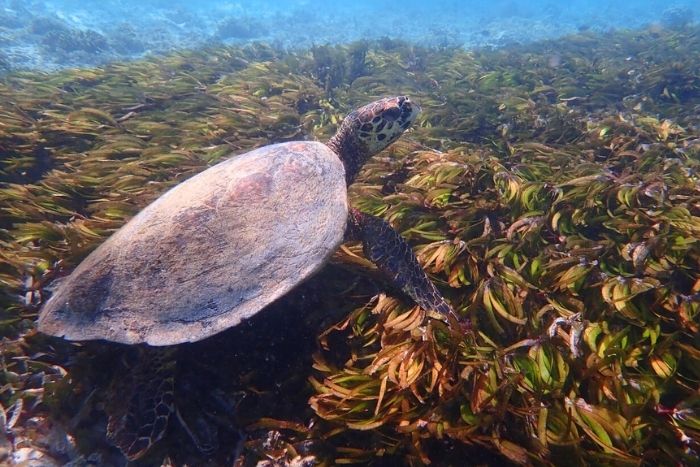
Although we have compeletd baseline data collection, we are still analysing our findings. However, there one early pattern stands out – we saw more juveniles and female hawksbills than males in seagrass beds.
Interestingly, this matches our broader Photo-ID findings, where most hawksbills recorded on shallow Maldivian reefs are juveniles. This could reflect historic population declines, leading to fewer adults. But it’s also possible that these reefs naturally serve as key developmental habitats for young sea turtles to grow. Adult hawksbills might be using other, less-surveyed areas.
Why is it important to study hawksbills’ use of seagrass meadows?
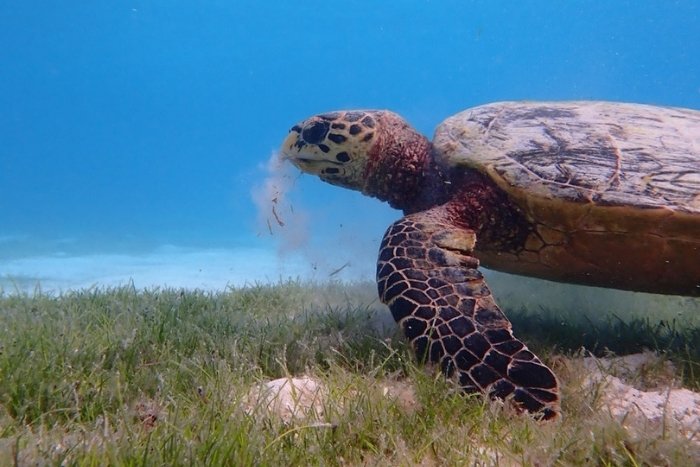
Since 2018, we have been sighting hawksbills in Maldivian seagrass meadows ever so often. Three reasons could explain this:
- an increase in seagrass areas
- more in-water surveys leading to greater sightings
- or a genuine shift in hawksbills’ use of habitats
Understanding which explanation is correct is important, since even small changes in habitat use can show how species respond to environmental change.
“While coral reefs are threatened across the Maldives due to climate change and development, a rise in seagrass cover has grabbed the attention of many conservationists and others working in the marine environment. Critically endangered hawksbill turtles are highly dependent on imperilled habitats and might have to find new foraging grounds in the future. We are hoping to better understand which role seagrass meadows could play for the species in the future.” says Dr. Stephanie Köhnk, Senior Project Scientist at ORP.
This study therefore can have important conservation implications like:
- Case for stronger seagrass protection: Seagrass meadows are expanding in parts of the Maldives, yet in some locations they are still cleared for coastal development. If critically endangered hawksbills are beginning to rely on these habitats, protecting seagrass becomes even more critical.
- Overlap with green turtles: Greater hawksbill use of seagrass could increase overlap with green turtle feeding areas. Monitoring this interaction can help us understand how species share and compete for resources.
- Pressure on seagrass beds: In some locations across the Indian Ocean, heavy grazing by green turtles has contributed to a decline in seagrass meadows. As seagrass beds are crucial to ocean health, understanding multi-species use of this critical habitat can help conservation planning.
- Understanding effect of climate change on habitats and species: Coral reefs are critical hawksbill habitat, but they are under increasing stress from repeated bleaching and warming seas. If hawksbills begin using seagrass more frequently, this could represent an early signal of behavioural adaptation to changing ocean conditions.
How can you help?
Divers, snorkellers, guides and citizens can help us in this effort, by submitting Photo-ID records of hawksbills (to seaturtleid@oliveridleyproject.org) observed in seagrass beds in the Maldives, including images and behaviour notes.
Acknowledgements
This study was carried out in collaboration with partners across multiple atolls, including Adam Athif Mohamed from Atoll Marine Centre in Lhaviyani Atoll, Rosalie Bailie from Coco Palm Dhuni Kolhu in Baa Atoll, and field teams in Laamu, including current, Juliette Fraser and former team members, Mikaela Dibble-Kahn.